Chinese Market Entry Strategy for a European Antique Jewellery Brand
From market opportunity to actionable go-to-market strategy

The Brief
Laurell’s Antique Jewellery, a UK-based online retailer specialising in European mid-century antique jewellery, was exploring expansion into China. I was brought in to assess the opportunity and develop a market entry strategy that could inform the brand’s decision-making.
The challenge was not simply about logistics or access. It required understanding whether a niche, high-value Western brand could build trust and relevance within a consumer market that operates on fundamentally different expectations.
My Approach
I structured the work around a core question: what would it actually take for this brand to succeed in this market — and is it viable?
This meant going beyond surface-level market sizing. The research needed to uncover how Chinese luxury consumers think, what drives their purchasing decisions in this specific category, and where the real barriers to entry lie.
Market & Macro Analysis
I began with an assessment of China’s current luxury landscape — examining macroeconomic conditions, structural shifts within high-end consumption, and how these trends specifically affect niche, heritage-driven categories. The goal was to understand not just whether demand existed, but what kind of demand it was and how it was evolving.
Consumer Psychology Research
Rather than relying on broad demographic profiling, I focused on the psychological drivers behind high-value purchasing decisions in this market. This involved analysing how consumer attitudes toward luxury, value, trust, and ownership have shifted in recent years — and what those shifts mean for a category like antique jewellery, where there is no standardised pricing, no universal certification, and limited brand familiarity.
Audience Segmentation
From the consumer research, I developed detailed psychographic personas representing the brand’s most promising initial audience — defined not just by demographics, but by their motivations, digital behaviours, and relationship to the category. These personas became the foundation for all subsequent strategic recommendations.
Competitive Landscape
I mapped the existing channels through which Chinese consumers access European antique jewellery — from major auction houses and international platforms to heritage luxury brands. The analysis focused on understanding where trust and authority sit in this market, and where the gaps are that a new entrant could credibly fill.
Strategic Positioning
Based on the research, I developed a positioning recommendation that reframed the brand’s role in this market. Rather than competing head-on with established channels, the strategy identified a differentiated position that leveraged the brand’s specific strengths while directly addressing the market’s primary friction points.
Go-to-Market Planning
The strategy extended into actionable planning across several dimensions:
- Product curation — Recommendations on initial inventory focus, category prioritisation, and price positioning based on market demand signals
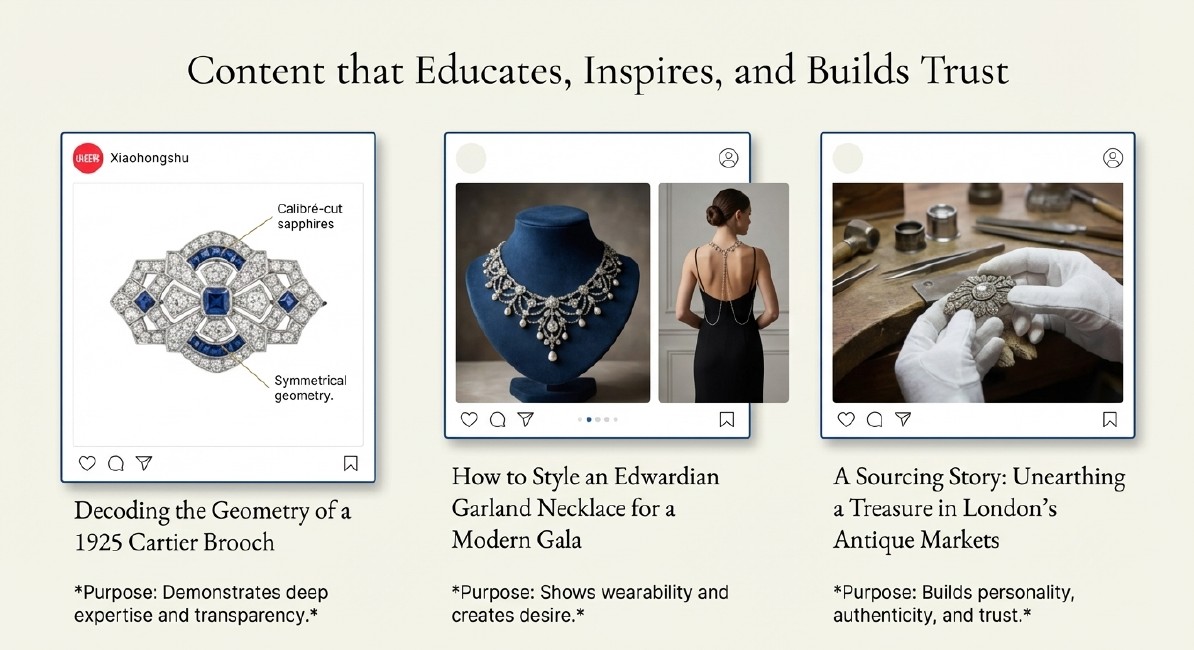
- Digital ecosystem design — A China-native channel strategy built around the platforms where the target audience actually discovers, researches, and purchases
- Cross-border operations — Service models addressing the logistical and regulatory complexities of high-value international purchases
- Risk mitigation — Identification of key market entry risks with corresponding strategic responses
What I Delivered
The final deliverable was a comprehensive strategic report covering:
- Macroeconomic and luxury market assessment
- Consumer psychology and behavioural analysis
- Psychographic audience segmentation
- Competitive landscape mapping
- Brand positioning strategy
- Go-to-market recommendations across product, digital, operations, and risk
The work was designed to give the client a clear, evidence-based foundation for their market entry decision — not just whether to enter, but precisely how.
Reflection
This project reinforced something I find consistently true in strategic work: the most important part of market entry is not the market itself — it’s the alignment between how a brand operates and how its target consumers think.
The opportunity was real. But capturing it required much more than translation and logistics. It required a strategy built on genuine understanding of consumer psychology, competitive dynamics, and the specific trust barriers that define cross-border luxury purchasing.
The challenge was never about access. It was about credibility.