3-Year Marketing Strategy for an American Accessible Luxury Brand in the Chinese Market
How can an accessible luxury brand strengthen its desirability in China's rapidly evolving consumer market?
The Context
Michael Kors has been present in the Chinese market for over a decade, building a recognisable brand with 120 stores across 30 cities by 2022. The brand’s “jet-set” aesthetic and accessible luxury price points have resonated with a broad consumer base.
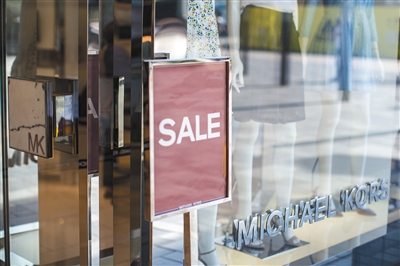
However, like many accessible luxury brands operating in China, Michael Kors was navigating an evolving competitive landscape. Consumer preferences had been shifting over the years, with younger shoppers increasingly gravitating toward either premium luxury houses or emerging domestic brands. On Chinese social media, the brand had acquired the colloquial label “aunty bags” among Gen-Z consumers, a perception shaped by frequent discounting and a customer base that skewed toward older, price-driven shoppers. This gap between brand aspiration and market perception is a challenge shared by many Western accessible luxury fashion brands in China.
This presented a meaningful strategic question: how does a well-established accessible luxury brand evolve its positioning and customer experience to remain desirable as the Chinese consumer market matures?
The Strategic Question
As part of my CIM Level 6 Diploma in Professional Digital Marketing, I chose Michael Kors as the subject for a strategic marketing planning assignment. Acting in the role of Marketing Manager, I was tasked with developing a 3-year marketing plan focused on enhancing customer satisfaction through service improvement.
I chose this brand because its parent company, Capri Holdings, had explicitly identified China as a key growth market and acknowledged in their 2022 annual report that the brand needed to better understand and respond to local consumer needs. At the same time, Bain & Company’s luxury market research highlighted that future industry growth would be driven by e-commerce, Chinese consumers, and the younger generation. The contrast between this growth ambition and the brand’s perception challenge on the ground made it an ideal subject for developing a customer satisfaction strategy.
The Diagnosis
I conducted a full strategic audit covering the macro environment, competitive landscape, and internal capabilities, anchored in data and conditions from the 2022–2023 period.
Market Environment (2022–2023)
The macro analysis revealed the Chinese market shaped by contradictory forces. The luxury sector was projected to recover with 9–14% growth after pandemic disruptions, yet the broader economy was under pressure. GDP growth had slowed significantly, and consumer confidence was uneven across income groups. Rising repatriation shopping trends meant consumers were increasingly purchasing luxury at home, while the “Guochao” (national pride) movement was accelerating preference for domestic brands among younger demographics.
Competitive Positioning
The competitive analysis highlighted the intensity of the accessible luxury segment in China. Rival brands were investing heavily in localisation, partnering with domestic designers, launching on emerging platforms, and expanding into lower-tier cities. The analysis revealed that the accessible luxury space was becoming more crowded from both ends: premium brands extending their reach downward, and domestic brands building upward.
For Michael Kors, the opportunity lay in leveraging its unique strengths: a broad product range spanning three price tiers, an established multi-channel distribution network, and a customer service philosophy (“Jet-Set-Go”) that already prioritised experience. The challenge was to sharpen how those strengths were communicated and experienced by consumers.
Internal Capabilities
The internal audit (using McKinsey’s 7S framework) revealed both strengths and areas for improvement. The brand had strong foundational assets, including dedicated customer service training programmes, an active social media presence across Chinese platforms, and experience with localised marketing through Chinese festival limited editions and celebrity partnerships.
At the same time, the analysis identified operational areas where investment could unlock significant gains: modernising digital systems to better capture customer data, reducing staff turnover through improved compensation structures, and improving cross-departmental coordination. A premium, experience-driven brand repositioning is ultimately contingent on stable, motivated retail personnel. Therefore, mitigating high frontline turnover and introducing service-focused incentives were established as critical prerequisites for elevating the external customer experience.
The Strategy
Repositioning Around Experience and Inclusivity
My central recommendation was to shift the brand’s competitive emphasis from price-driven value toward experience-driven value. Michael Kors already had the DNA for this. Its product range naturally serves diverse consumer needs, and its Diversity & Inclusion ethos provided an authentic foundation for inclusive brand storytelling.
This repositioning would allow the brand to communicate a clearer message: accessible luxury defined not by discounts, but by the breadth and quality of the experience it offers.
Audience Segmentation
I developed five distinct audience segments based on income tiers, psychographic profiles, and purchasing motivations, each with tailored value propositions and channel strategies:
- Premium-seeking professionals → Collection line with VIC experiences
- Fashion-forward younger consumers → Accessible line with digital engagement and local collaborations
- Sustainability-conscious consumers → Emphasis on the brand’s ESG commitments and supply chain transparency
- Value-oriented consumers seeking versatility → Repair services, flexible payment options, and multi-occasion styling
- Lower-tier city consumers discovering the brand → Online outlet and community-led engagement
Growth Strategy Sequencing
Using Ansoff’s matrix, I recommended a phased approach that prioritised lower-risk strategies first:
- Market penetration: Strengthen the existing customer base through improved service, upgraded digital infrastructure, and deeper customer relationships
- Product development: Collaborate with local designers and cultural figures to create China-relevant collections
- Market development: Expand into lower-tier cities and digital channels as capabilities mature
- Diversification: Explore new categories (rental, resale) once the foundational strategies have stabilised
This sequencing was validated through a SAF (Suitability, Acceptability, Feasibility) assessment, ensuring each phase was realistic given the brand’s current resources and market conditions.
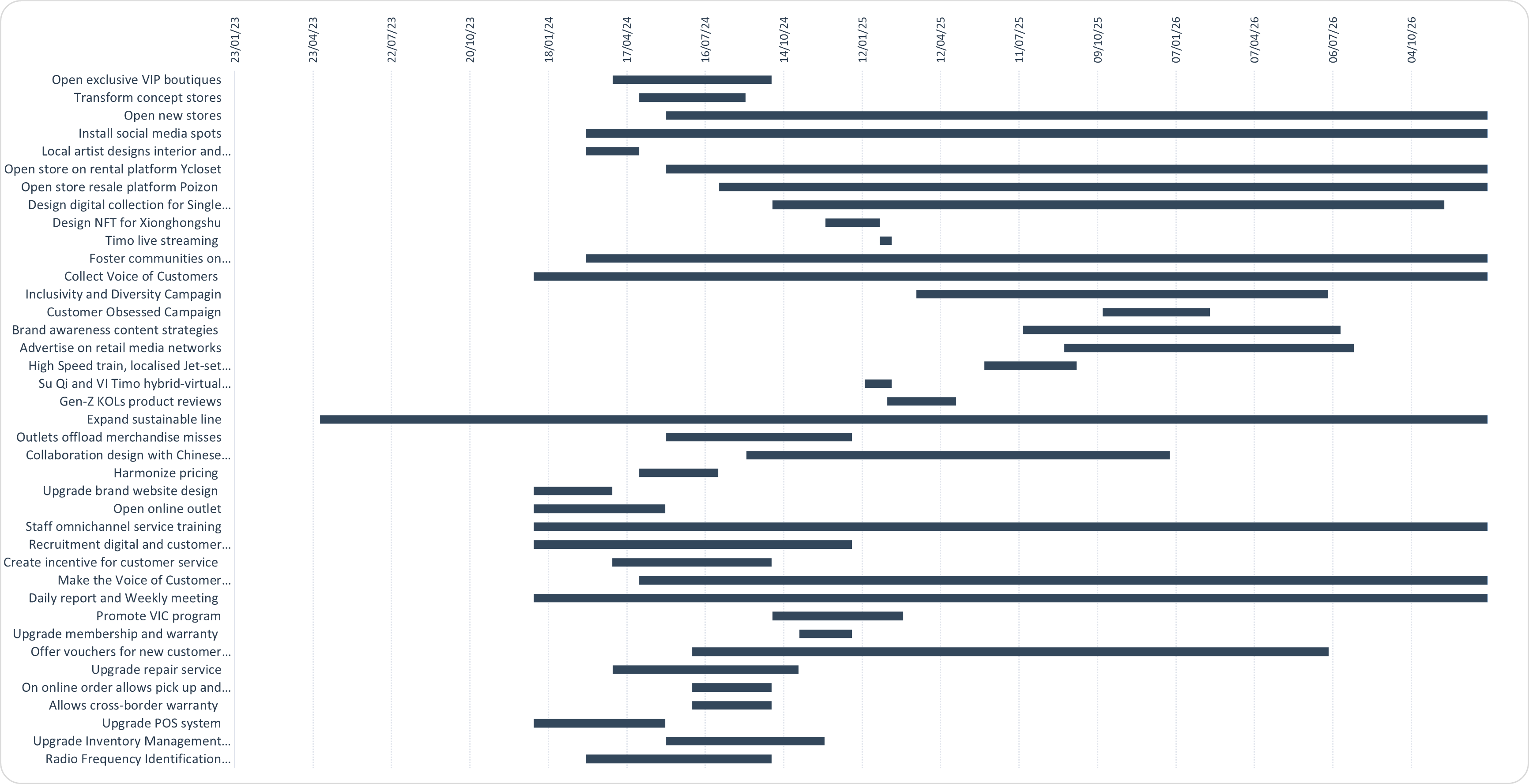
Measurement Framework
I designed a KPI framework aligned to the Chaffey & Smith 5S model, measuring revenue growth, conversion rates, customer satisfaction, operational efficiency, and brand awareness. The framework included both leading indicators (engagement metrics, sentiment analysis) and lagging indicators (market share, customer lifetime value), with specific tools recommended for the Chinese digital ecosystem.
Expected Outcomes & Future Metrics
Disclaimer: As this project is an academic study, the figures and outcomes presented below are based on theoretical forecasting and industry benchmarks, rather than live business execution data.
Success was mapped against the Chaffey & Smith 5S framework with specific outcomes to be tracked over the 3-year scope:
- Sell: Increase annual revenue to $1 billion and achieve a 1% market share in China.
- Serve: Increase physical store conversion rates to 16% through upgraded clientele service capabilities.
- Speak: Achieve a minimum 95% overall customer satisfaction rate, acting as a leading indicator of sentiment shift.
- Save: Increase repeat point-of-sale (POS) service efficiency by 50% through upgraded digital operations.
- Sizzle: Reach a 40% top-of-mind brand awareness among the target demographic.
Methodology
Diagnostic Tools
- PESTEL & Porter’s Five Forces: Macro and micro environment analysis.
- McKinsey 7S: Internal capability audit.
- TOWS Matrix: Strategic option generation.
Strategic Planning Models
- Porter’s Generic Strategies & Ansoff’s Matrix: Competitive positioning and growth sequencing.
- McKinsey’s Consumer Decision Journey: Customer touchpoint analysis.
- Chaffey & Smith’s 5S & Hooley’s Framework: Objective setting and mission evaluation.
- 7P Marketing Mix: Tactical delivery planning.
Reflection
This assignment was completed as part of my CIM Level 6 Diploma in Professional Digital Marketing, a professional qualification from the Chartered Institute of Marketing. The analysis was conducted within an academic context, with strategic recommendations based on publicly available data up to 2023.
The central insight from this project was that the perception gap described above was not an awareness problem. It was a messaging problem. Years of heavy, year-round discounting had sent a persistent, unintended message to Chinese Gen-Z consumers: this brand is cheap. Every promotion reinforced that signal, and over time it overrode whatever the brand intended to communicate about itself. The gap between how Michael Kors saw itself and how its target audience perceived it widened with every discount cycle.
What this taught me is that pricing behaviour is brand communication. When the loudest message a brand sends is about price, that becomes the brand’s identity in the consumer’s mind, regardless of the heritage, the campaigns, or the aspiration behind it. Closing that gap requires more than repositioned advertising. It requires elevating the entire brand experience, from product design and in-store service to culturally resonant, localised storytelling that connects with what Chinese consumers actually value.
Customer satisfaction is not just a service metric. It is the mechanism through which a brand rebuilds its image, one interaction at a time.