Conversion Optimisation Strategy for an Influencer-Led Beauty Brand
How can a viral influencer-led beauty brand optimise its digital experience to sustain growth and combat under-consumption?
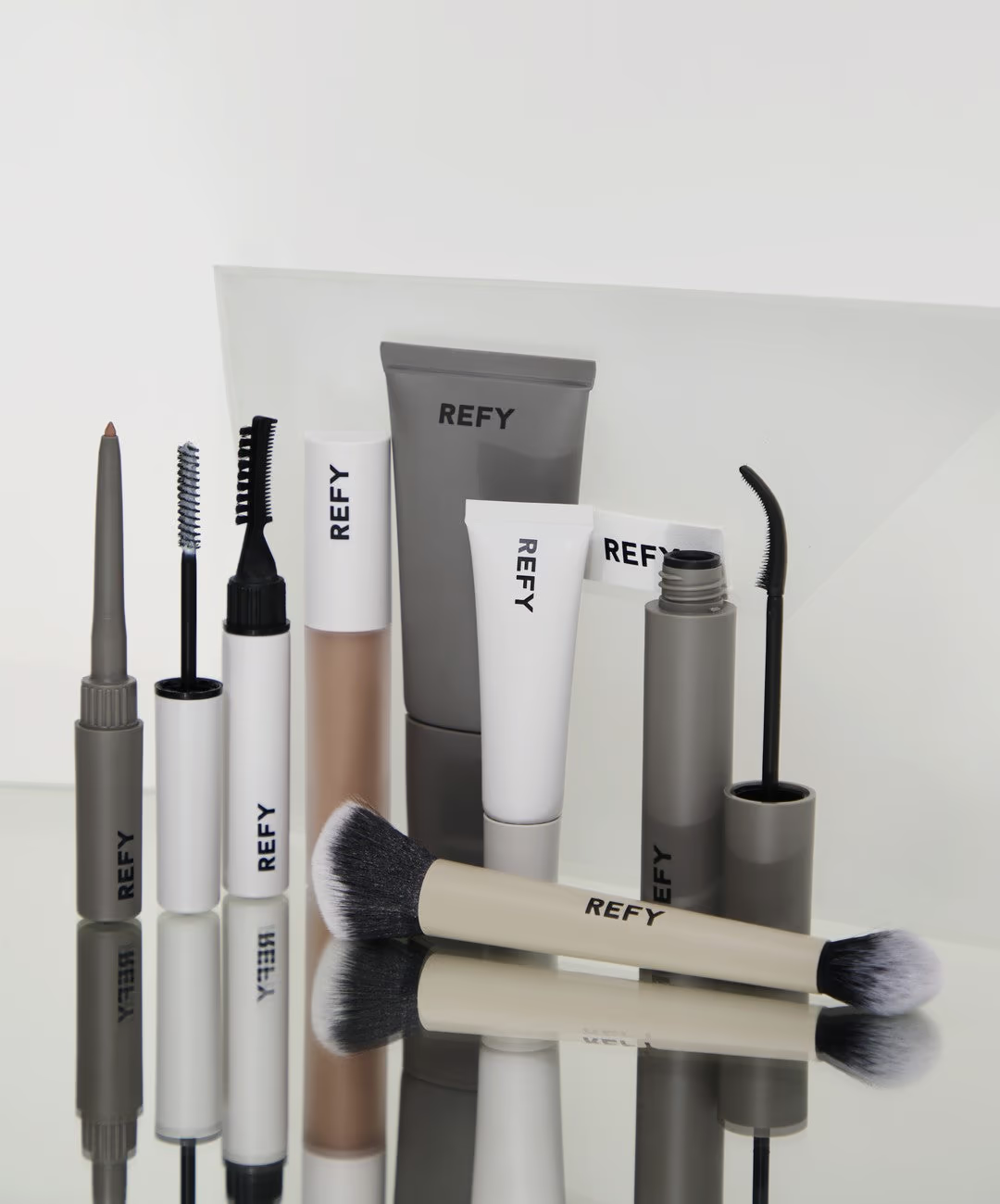
The Context
Founded in 2020 by Jess Hunt and Jenna Meek, Refy Beauty is an influencer-led beauty brand widely recognised for its innovative, multifunctional products and minimalist “clean girl” aesthetic. Generating impressive YoY growth to reach £24.8M in revenue by 2023, Refy operates predominantly as a direct-to-consumer (DTC) brand alongside strategic retail partnerships with Sephora and Selfridges.
However, the rapid growth phase meant navigating shifting macro conditions. The market was encountering an “under-consumption” trend driven by economic pressures, alongside increasing consumer demands for authentic sustainability and inclusivity. While Refy benefited from massive social media traction by fostering a collective audience of over 1 million and drawing substantial direct and Instagram traffic, website analytics told a different story. Below-average session durations and lower pages per visit indicated significant friction in the user journey.
The Strategic Question
This project was completed as part of my CIM Level 6 Diploma in Professional Digital Marketing (Digital Optimisation module). Acting in the role of Digital Marketing Manager, I was challenged to develop a data-driven Conversion Rate Optimisation (CRO) plan.
The core strategic question was: How can a high-traffic, social-first beauty brand optimise its digital touchpoints to reduce decision paralysis, extend user engagement, and drive sustainable revenue growth?
The Diagnosis
I conducted a comprehensive digital capability and environmental audit to pinpoint the brand’s position and vulnerabilities within the user journey.
Digital Capability & Environmental Audit
The macro analysis identified several critical shifts in the beauty market. Alongside economic caution, consumers demonstrated a growing expectation for sophisticated digital experiences, hyper-personalisation, and genuine inclusivity. A competitor analysis evaluating digital leaders like Glossier and Milk Makeup revealed that while Refy possessed strong community ties and category-defining products, its digital ecosystem lagged in supportive tools like virtual try-ons or advanced purchase personalisation.
Internally, Refy held strong assets in team agility, engaged social audiences, and influencer integration, but fell short on onsite customer service capabilities (like AI chatbots) and visible sustainability credentials.
Conversion Funnel Audit
A detailed CRO audit surfaced key bottlenecks in the path to purchase:
- Traffic vs. Engagement: Despite a healthy influx of mobile-first direct traffic, the average session duration sat at just 1:21 minutes with only 3.54 pages per visit. These figures are well below the industry benchmarks of 2-3 minutes and 5+ pages.
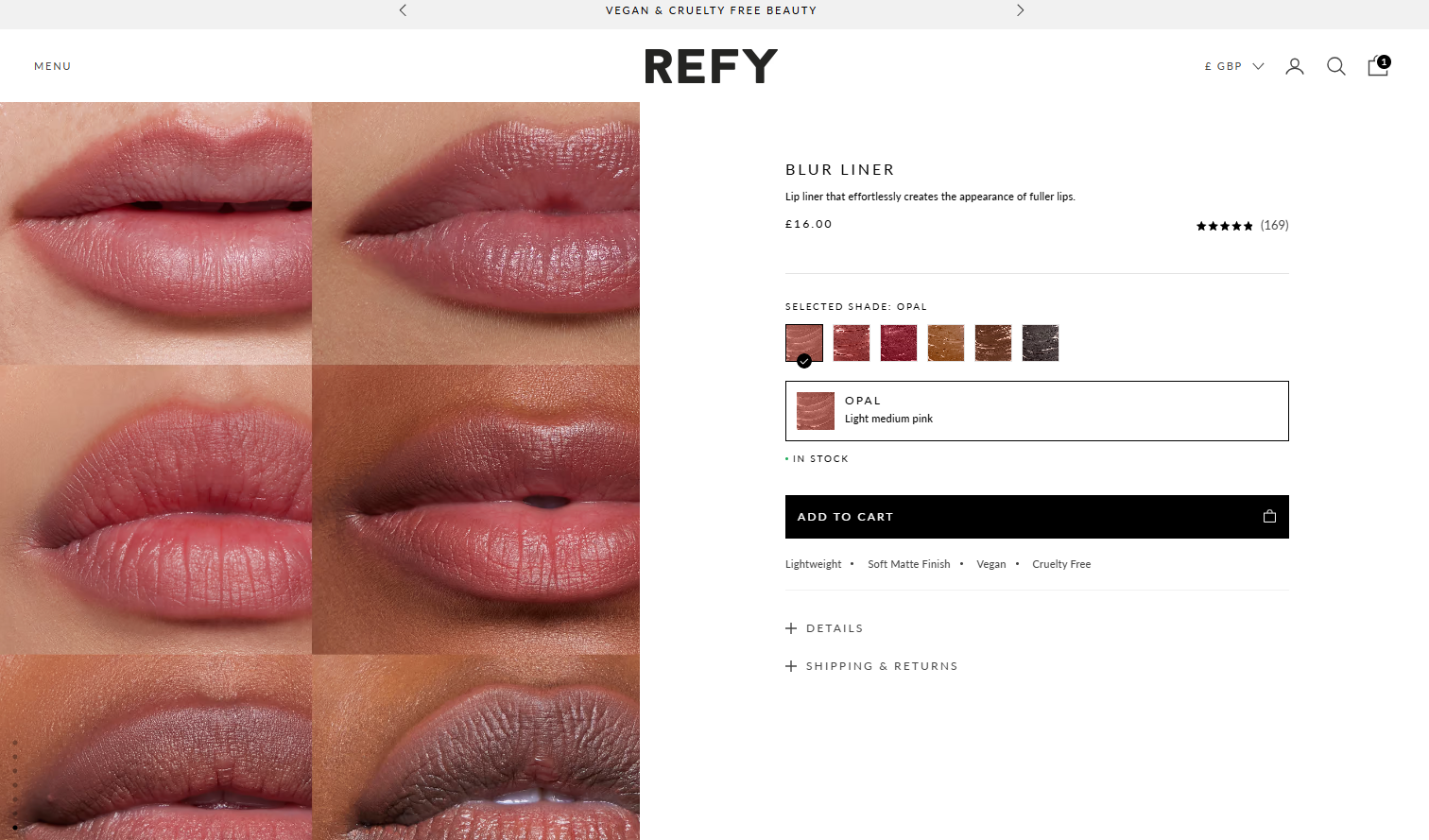
- Consideration Friction: Product detail pages (PDPs) lacked adequate interactive decision-making support. Crucial information was buried below the fold, resulting in choice paralysis when selecting shades for products like the lip liner.
- Lost Opportunities: There was an absence of compelling CTAs, “Save for Later” functions, and urgency-driven cart nudges, collectively contributing to premature exits and cart abandonment.
Audience Persona & Journey Mapping
Utilising the STP framework, I defined the primary target persona: the “Innovation Enthusiast.” This digital-native user seeks minimalist beauty routines and high-performance products but requires substantial visual reassurance to build purchase confidence. Journey mapping highlighted the “Consideration” stage as the most vulnerable inflection point, where indecisiveness regarding product compatibility frequently severed the conversion funnel.
The Strategy
CRO Hypothesis & Prioritisation
Drawing from the journey map insights, I formulated four optimisation hypotheses. To ensure impactful resource allocation, I applied the PIE (Potential, Importance, Ease) scoring system.
The prioritised, winning hypothesis addressed decision paralysis directly: If we enhance the visual decision-making support tools on the product detail page, we will increase the add-to-cart rate, by empowering customers to confidently visualise how products match their specific needs.
A/B Test Design
I designed a rigorous A/B testing framework targeting the high-traffic product detail pages:
- Primary Goal: Reduce landing page bounce rates and elevate the macro “Add to Cart” conversion rate.
Original Layout (Control): The existing product detail page lacking clear shade comparison support.
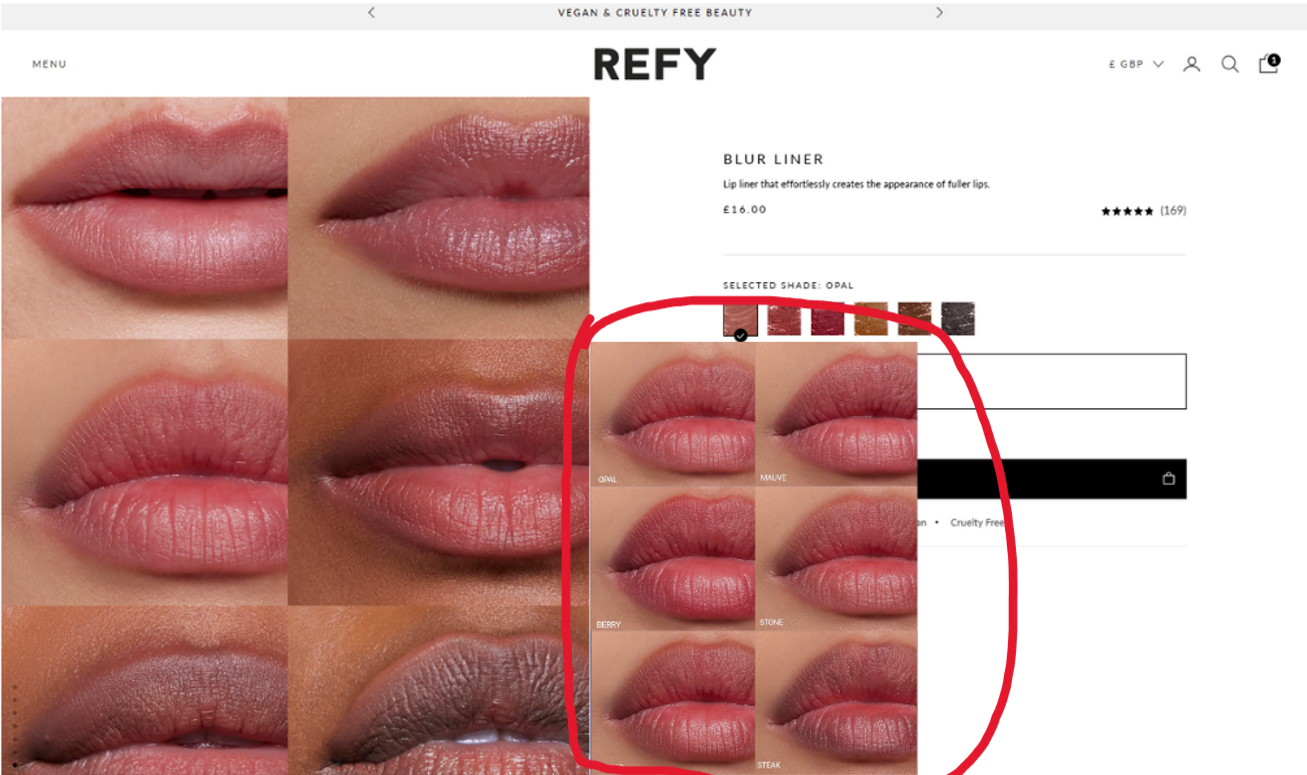
Variant 1: A static image carousel facilitating direct shade comparisons on diverse skin tones.
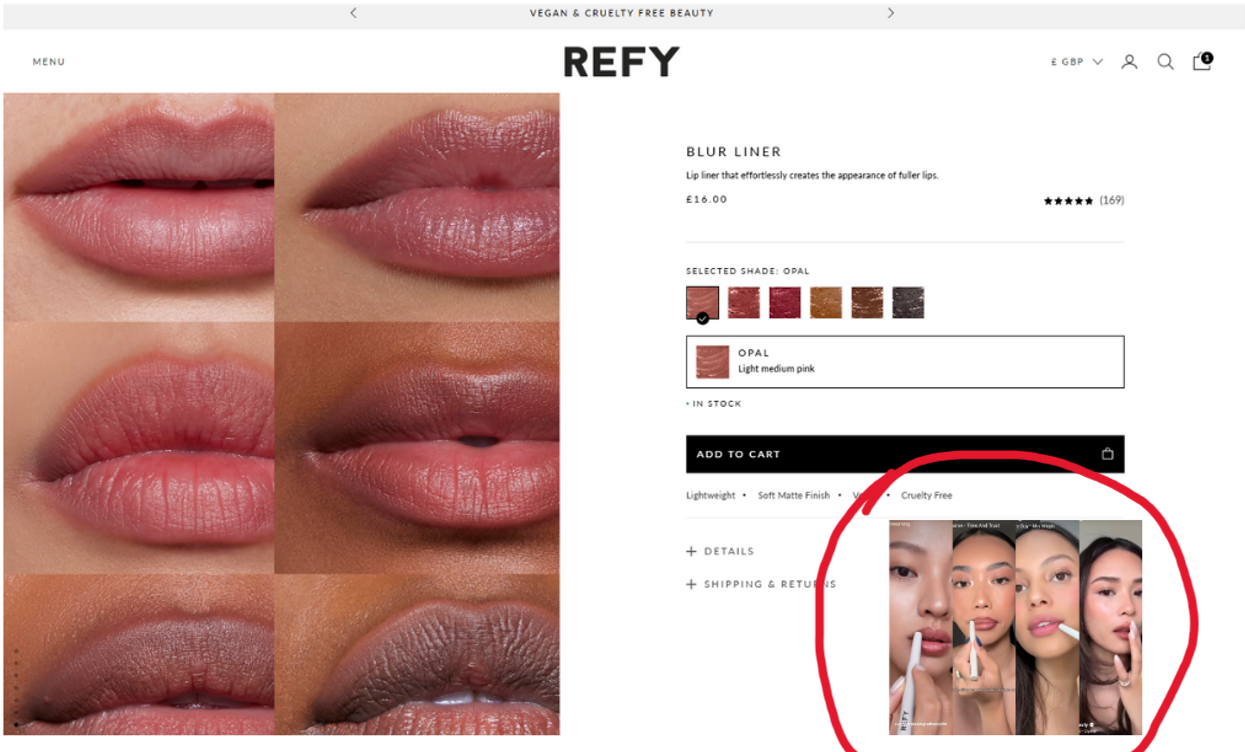
Variant 2: Hover-activated, user-generated content (UGC) videos corresponding to specific shades.
Variant 3 (The Winning Concept): An interactive product shade-matching quiz prominently integrated into the user flow.
This was executed via a direct CTA on the product page leading to an interactive quiz overlay.
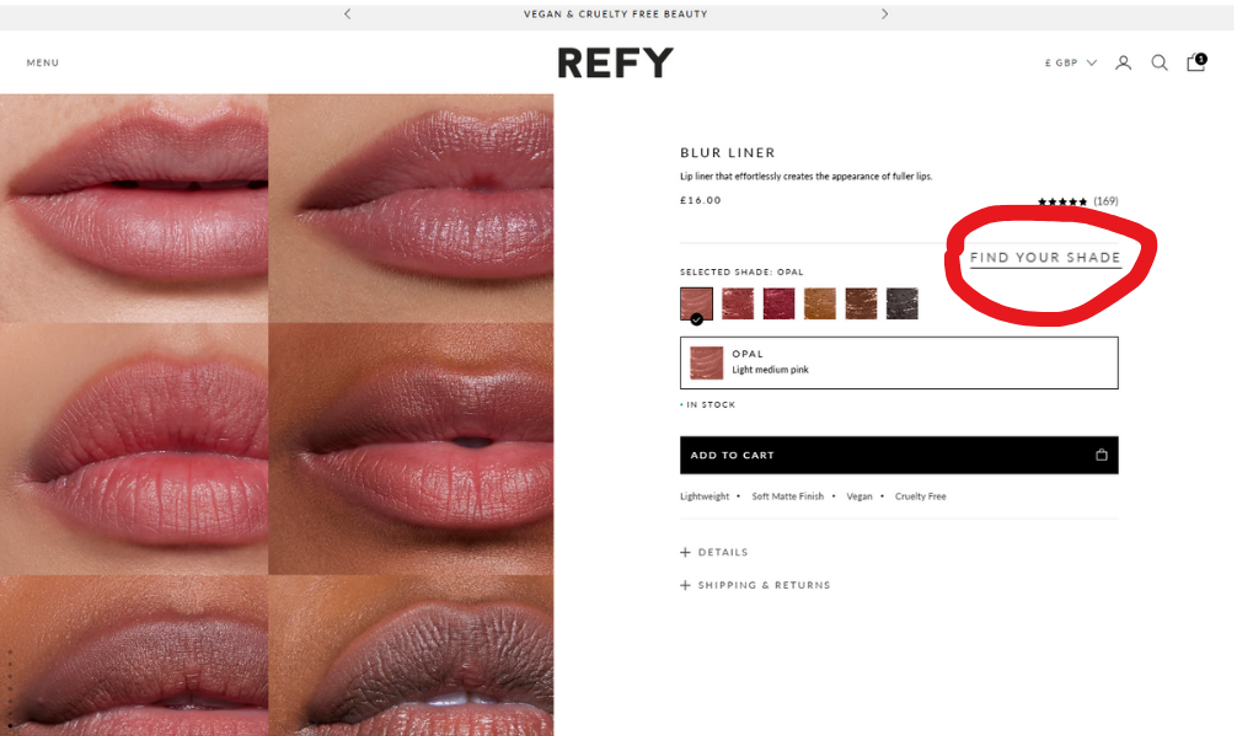
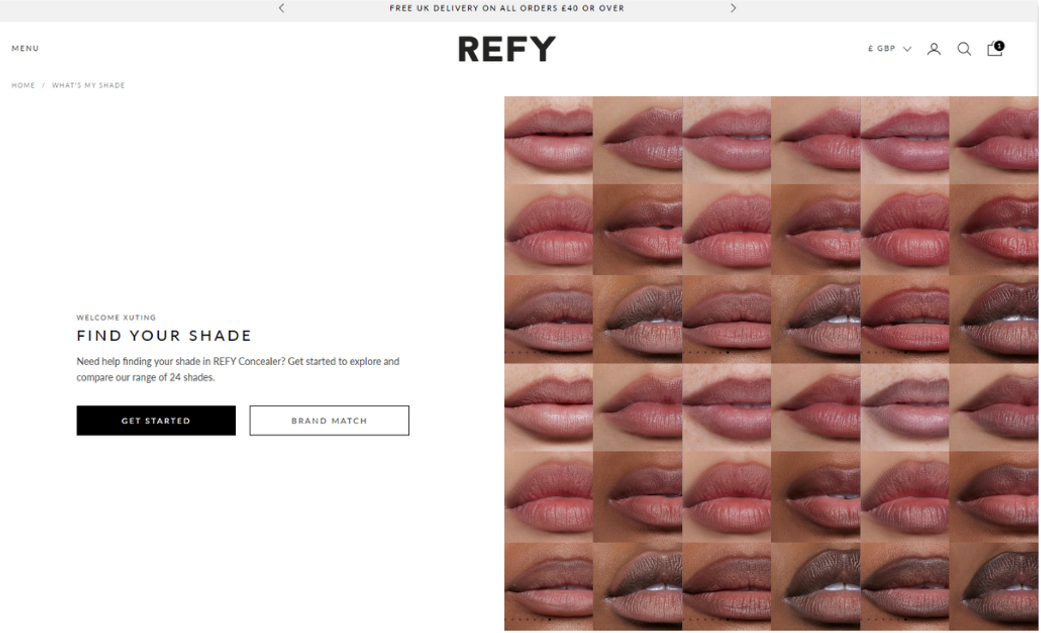
Financial and strategic modelling demonstrated that Variant 3 offered the most lucrative and brand-aligned solution, effectively bridging the gap between Refy’s minimalist ethos and the user’s need for personalised guidance.
Measurement Framework & ROI
A dual quantitative and qualitative KPI framework was crafted to monitor the plan’s efficacy:
- Primary Metrics: Bounce Rate, Average Session Duration, Add-to-Cart Rate.
- Secondary Metrics: Conversion funnel drop-off rates, CTR on new features, and qualitative user feedback via session recordings and surveys.
The business case for deployment was robust. Based on industry benchmarks and baseline data, the intervention projected a conversion uplift from 2.1% to 3.0%. Factoring in an estimated development and testing cost of £3,200, the intervention projected an annualized revenue uplift of £45,360—delivering an estimated ROI of 1,318%.
Disclaimer: As this project is an academic study, the figures and financial outcomes presented are based on theoretical forecasting and industry benchmarks, rather than live business execution data.
Expected Outcomes & Future Metrics
To ensure sustained growth, the CRO plan extended into a long-term improvement lifecycle using the PDCA (Plan-Do-Check-Act) framework.
- Short-term Initiatives: Deployment of the interactive quiz, deployment of non-intrusive UX features (like “Save for Later”), and improved CTA visibility to maximise existing traffic engagement.
- Long-term Initiatives: Maturing the digital ecosystem through the introduction of virtual try-on tech, launching a structured loyalty and rewards program, and establishing subscription models (e.g., “Subscribe & Save”) to maximise Customer Lifetime Value and mitigate rising acquisition costs.
Methodology
Diagnostic Tools
- STEEPLE & Porter’s Five Forces: Macro and micro environmental analysis.
- 5M & ESG Frameworks: Digital capability and sustainability audits.
- SWOT Analysis: Evaluation of internal strengths and external market factors.
CRO & Strategic Models
- STP Framework & Buyer Journey Mapping: Audience segmentation and friction identification.
- PIE Scoring System: Data-driven hypothesis prioritisation.
- Chaffey & Smith’s 5S & Hooley’s Framework: Objective setting and competitor evaluation.
- PDCA Cycle: Continuous improvement and iterative testing methodology.
Reflection
This assignment was completed for the Digital Optimisation module of the CIM Level 6 Diploma in Professional Digital Marketing. The analysis was conducted within an academic context, leveraging publicly available and simulated platform data up to 2024.
The defining insight from this project is that high traffic does not automatically equal high conversion if the digital environment fails to build confidence. Refy excels at generating top-of-funnel hype through masterful influencer marketing and sleek branding, but a website’s ultimate role is to convert that excitement into decisive action.
Decision paralysis is often misdiagnosed as low purchase intent, when in reality, it is a symptom of insufficient guidance. By strategically integrating confidence-building digital tools such as an interactive shade quiz, brands can bridge the gap between social media inspiration and e-commerce execution. Conversion optimisation isn’t strictly about moving buttons or changing colours; it is about anticipating the user’s psychological needs at every stage of the digital journey.